
Types of Dinosaurs: Main Groups, T. rex and Stegosaurus
In short
- Dinosaurs fall into two big branches, lizard-hipped and bird-hipped, and into a handful of main groups: theropods, sauropods, armoured dinosaurs, ornithopods and horned dinosaurs.
- T. rex was a two-legged theropod from the very end of the Cretaceous; Stegosaurus was a four-legged plant-eater with back plates from the Late Jurassic. Around 80 million years lie between them.
- Pterosaurs and sea reptiles such as plesiosaurs were not dinosaurs. Birds are: they descend from small theropods.
Types of dinosaurs are easier to sort than the long names suggest. Scientists have named around a thousand species so far, yet almost all of them fit into a handful of groups that you can recognise by the legs, the neck and whatever grows on the back or the head.
We print dinosaur figures, so we wanted to get the family tree right ourselves. Below: the main groups in one table, the two branches behind them, a short look at T. rex, a longer one at Stegosaurus, and the animals that are often called dinosaurs but are not.
The main types of dinosaurs at a glance
| Group | How to recognise it | Well-known examples | Food |
|---|---|---|---|
| Theropods | Walked on two legs, three main toes, sharp teeth in most | Tyrannosaurus, Allosaurus, Velociraptor, Spinosaurus | Mostly meat or fish |
| Sauropods | Very long neck and tail, small head, four pillar-like legs | Diplodocus, Brachiosaurus, Argentinosaurus | Plants |
| Stegosaurs | Plates or spikes along the back, spiked tail, small head | Stegosaurus, Kentrosaurus | Plants |
| Ankylosaurs | Low, wide body covered in bony armour; some had a tail club | Ankylosaurus, Euoplocephalus | Plants |
| Ornithopods | Beak, no armour, walked on two or four legs; some had head crests | Iguanodon, Parasaurolophus, Edmontosaurus | Plants |
| Ceratopsians (horned dinosaurs) | Beak, bony neck frill, often horns | Triceratops, Styracosaurus, Protoceratops | Plants |
Two branches: lizard-hipped and bird-hipped
Since the 19th century, dinosaurs have been divided by the shape of their hip bones. In lizard-hipped dinosaurs (saurischians) the pubic bone points forward, as in lizards. This branch holds the theropods and the sauropods with their early relatives. In bird-hipped dinosaurs (ornithischians) the same bone points backwards. All of them were plant-eaters: stegosaurs, ankylosaurs, ornithopods, horned dinosaurs and the dome-headed pachycephalosaurs.
The names are a little misleading. Birds descend from small theropods, so they come from the lizard-hipped branch, not the bird-hipped one.
Dinosaurs appeared in the Triassic, roughly 230 to 240 million years ago, flourished through the Jurassic and the Cretaceous, and died out about 66 million years ago, all except the birds.
T. rex facts in brief: the best-known theropod
Tyrannosaurus rex shows what makes a theropod: it walked on two strong hind legs, held its body level and balanced a huge head with a long tail. It lived in western North America at the very end of the Cretaceous, roughly 68 to 66 million years ago, and at around 12 metres long it was one of the largest land predators ever.
Its arms were short, with two fingers on each hand, while many other theropods had three. Not every theropod was a giant: Velociraptor was about the size of a turkey and had feathers. We go through the skull, teeth and arms bone by bone in our T. rex skeleton guide.


Read also: T-Rex Skeleton: What It Is Made Of and What the Bones Reveal · Bearded Dragon Facts: Beard, Arm Waving and a 25 cm Figure
Stegosaurus facts: plates, tail spikes and a small head
Stegosaurus is a dinosaur most people recognise by its outline alone. It lived in the Late Jurassic, roughly 155 to 145 million years ago; most finds come from western North America, and one from Portugal.
- Size. Adults were roughly 6 to 9 metres long and walked on four legs.
- Plates. Two rows of large bony plates ran along the neck, back and tail. They sat in the skin and were not attached to the spine. What they were for is still debated: display, recognising one another and perhaps regulating body temperature.
- Tail spikes. The tail ended in four long spikes, used for defence. Palaeontologists call this weapon a thagomizer, a word borrowed from a Far Side cartoon by Gary Larson.
- Head and food. The head was small and narrow and carried low to the ground, with a toothless beak at the front and small cheek teeth behind. Stegosaurus ate low-growing plants.
What is not a dinosaur
A practical test is the legs: dinosaurs held them straight under the body, like a horse or a bird, while lizards and crocodiles sprawl theirs out to the sides.
- Pterosaurs, such as Pteranodon, were flying reptiles and close relatives of dinosaurs, but a separate group.
- Plesiosaurs, ichthyosaurs and mosasaurs were marine reptiles.
Today's lizards are not small dinosaurs either, however ancient a bearded dragon may look. The only living dinosaurs are birds.
Dinosaurs for the desk: our figures
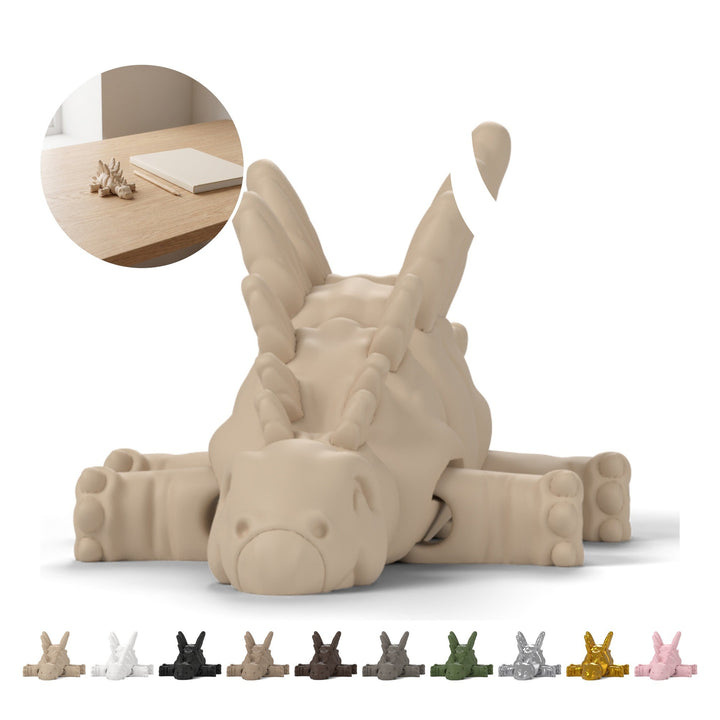
Our articulated T-Rex, 15.5 cm, and the flexi stegosaurus, 11.4 cm, are printed from PLA in one piece, with the joints already in place: no assembly, no glue. Both come in ten colours. To be honest, they are stylised desk figures and fidgets for dinosaur fans, not scale models: you will recognise the group at a glance, but do not count vertebrae on them.
All dinosaurs hatched from eggs, even the giant sauropods, whose eggs were about the size of a football at most. Our two dinosaur egg trinket boxes with raised spots and with a cracked shell are 6.7 cm tall and open into two halves, with room inside for a ring, a pair of earrings or a coin. They are decorations, not copies of real fossil eggs and not food containers.


For bones rather than skin, there is the flexi T-Rex skeleton, 15.5 cm, and the Triceratops kit card, 25 cm, a horned dinosaur you snap together by hand without glue. All of them are in our Dinosaurs collection; more articulated animals, from sharks to lizards, are in Flexi Animals.
Safety: the articulated T-Rex and the stegosaurus are marked 14+ because of small parts; we see them as collectibles and desk fidgets for teens and adults. All our articulated figures and the Triceratops kit have small parts and are not suitable for children under 3.
Questions about dinosaur types
How many types of dinosaurs were there?
Around a thousand species have been named so far, and new ones are described every year. The exact figure depends on who is counting, because some names turn out to describe the same animal.
Did T. rex and Stegosaurus live at the same time?
No. Stegosaurus lived in the Late Jurassic and T. rex at the very end of the Cretaceous, around 80 million years later. That gap is longer than the 66 million years between T. rex and us.
Did Stegosaurus have a second brain?
No. There is a widened space in the spine above the hips, which gave rise to the old idea of a “second brain”. The real brain was in the head, and it was small for an animal of that size.
Products from this guide
-
T-Rex Dinosaur Skeleton Figure 15.5 cm, 3D Printed Flexi Articulated, PLA
Regular price 39,99 złRegular price -
Triceratops Dinosaur Kit Card – 3D Printed Snap-Together Model – 25 cm
Regular price 39,99 złRegular price -
Articulated T-Rex Figure 15.5 cm, Flexi Dinosaur with Movable Joints, 3D Printed
Regular price 25,99 złRegular price -
Flexi stegosaurus figure 11.4 cm, articulated mini dinosaur, 3D printed
Regular price 20,99 złRegular price -
Dinosaur Egg Trinket Box 6.7 cm, Raised Spots, Opening Lid, PLA
Regular price 20,99 złRegular price -
Dinosaur Egg Trinket Box 6.7 cm, Cracked Shell, Opening Lid, PLA
Regular price 21,99 złRegular price




Read next
Unicorn vs Pegasus vs Alicorn: What Is the Difference?
Unicorn vs Pegasus vs alicorn: who has the horn, who has the wings, where each one comes from in myth and history, and what an alicorn actually is.
Read →Moose Facts: Moose vs Elk and How Big Is a Moose
Moose facts in plain numbers: moose vs elk explained for British and American English, how big is a moose, how its antlers grow and where it lives.
Read →Shark Facts: How Sharks Swim and What Makes a Great White
Shark facts: why sharks have no bones, how a great white shark swims with its tail and how species differ, from the whale shark to the hammerhead.
Read →


