
Unicorn vs Pegasus vs Alicorn: What Is the Difference?
In short
- A unicorn has one horn and no wings. Pegasus has wings and no horn. An alicorn has both.
- Pegasus comes from Greek mythology, the unicorn from ancient accounts and medieval bestiaries. The alicorn, a winged unicorn, belongs to modern fantasy; the word itself once meant the unicorn's horn.
- We print all three as 14.1 cm articulated figures for ages 14+.
Unicorn vs Pegasus vs alicorn: the three are mixed up all the time, because each is a horse and each is magical. The difference is easy to see on the forehead and on the back: a horn, a pair of wings, or both.
We print all three as small articulated figures in Poland, so here is the proper answer, with the stories behind each.
Unicorn, Pegasus, alicorn: the difference at a glance
| Creature | Horn | Wings | Where it comes from | What it stands for |
|---|---|---|---|---|
| Unicorn | Yes, one, on the forehead | No | Ancient accounts of a one-horned animal, medieval bestiaries | Purity, something rare and untameable |
| Pegasus | No | Yes | Greek mythology | Inspiration, poetry, flight |
| Alicorn | Yes | Yes | Modern fantasy; the word used to mean the unicorn's horn | A blend of both, with no old tradition |
An easy way to remember it: the Latin unicornis means “one-horned”, and Pegasus is the proper name of one particular horse.
Unicorn facts: the animal nobody could catch
The unicorn does not come from Greek mythology. It first appears in ancient writings about distant lands, described as a real animal. The earliest known account is by the Greek physician Ctesias, around 400 BC, who wrote of a wild one-horned animal living in India.
Medieval bestiaries turned it into a symbol. There the unicorn is so swift and fierce that no hunter can take it, and it grows gentle only beside a maiden. That is how it came to stand for purity and innocence.

Its horn was believed to protect against poison, and for centuries narwhal tusks were sold in Europe as unicorn horns. In heraldry it is best known from Scotland: the unicorn is Scotland's national animal and stands opposite the English lion on the royal coat of arms of the United Kingdom.
Pegasus facts: the winged horse of Greek mythology
Pegasus is Greek mythology through and through. He sprang from the blood of the Gorgon Medusa when the hero Perseus cut off her head, and his father was Poseidon, god of the sea.
His rider was Bellerophon, who tamed him with a golden bridle from the goddess Athena and, on his back, defeated the fire-breathing Chimera. Later Bellerophon tried to fly up to Olympus, the home of the gods. Zeus sent a gadfly to sting the horse, the rider fell, and Pegasus went on alone.

Where his hoof struck Mount Helicon, the spring Hippocrene is said to have risen, sacred to the Muses. Ever since, Pegasus has stood for poetic inspiration, and a constellation in the northern sky bears his name.
Read also: Dragon Symbolism: What a Dragon Means in Different Cultures · Chinese Dragon Meaning: Symbols, Zodiac and the Western Dragon
What is an alicorn?
An alicorn is a winged unicorn: a horse with a horn on its forehead and a pair of wings. You will not find it in the Greek myths or in medieval bestiaries. As a creature with its own name it belongs to modern fantasy: books, games and animated films have made it popular.
The word itself is older and used to mean something else. Historically, “alicorn” was a name for the horn of the unicorn, the very object traded as protection against poison. Only in modern fantasy did the word move from the horn to the whole winged animal.

So alicorn vs unicorn comes down to the wings, and alicorn vs Pegasus to the horn.
What the three stand for today
Today the unicorn is shorthand for something rare and one of a kind. Pegasus still stands for imagination, which makes him a favourite of people who write, draw or simply love the Greek myths. The alicorn has no old tradition behind it, so it means what modern stories make of it: usually the rarest of the three.
As a small present for someone aged 14 or over: a unicorn for someone one of a kind, Pegasus for someone creative, an alicorn for someone who can never decide.
Our three figures: same size, different details
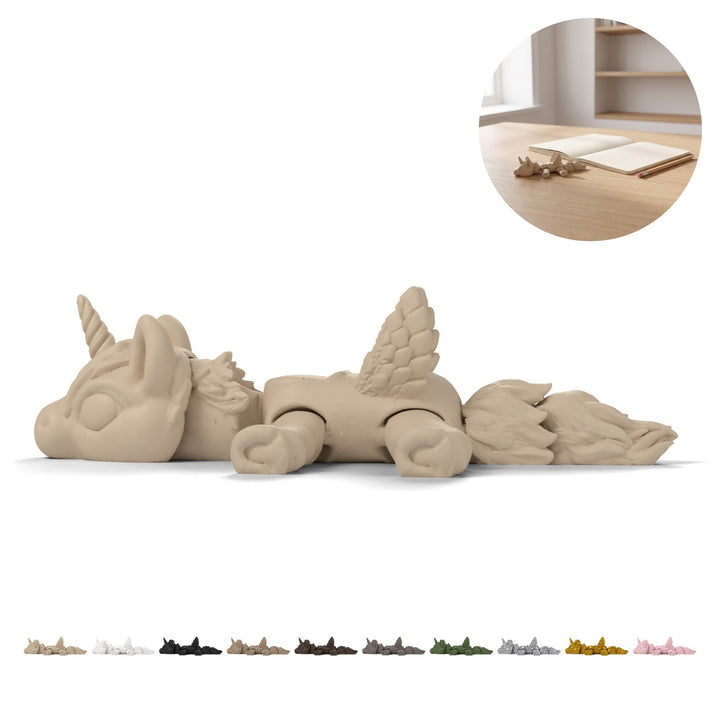
Our flexi unicorn, articulated Pegasus and flexi alicorn are each 14.1 cm long and weigh about 30 g. Each is 3D printed from PLA in one piece together with its joints, so it moves straight off the printer, with no glue and no assembly. The difference is exactly the one from the table: a horn, wings, or both.
Each comes in ten colours, from beige and white to silk gold and pink. We print to order in Poland and ship within 24–48 hours. On a desk the figure works as a fidget toy that keeps your hands busy during a call, on a shelf as a small collectible. More of this kind is in Fidget Toys.
Safety note: all three figures contain small parts and are intended for people aged 14 and over. Keep them away from heat sources.
One honest remark: the figures are small, stylised and lie flat on their bellies. They are not statues of a rearing horse.
More winged creatures of legend: dragons
Wings are not reserved for horses. The dragon is the other great winged creature of European legend; what it means in different cultures is in our article on dragon symbolism. In our range: the winged dragon figure, 20 cm, a decorative collectible for ages 14+, and the winged dragon in an egg, a 20 cm articulated dragon in a 10 cm egg. Both are in Dragons.
See our flexi figures and desk fidgets
Questions about unicorns, Pegasus and alicorns
Is a unicorn with wings still a unicorn?
Strictly speaking, no. A unicorn has a horn and no wings. A horse with both is called an alicorn, or simply a winged unicorn.
Does Pegasus have a horn?
No. In Greek mythology Pegasus is a winged horse without a horn. A horn and wings together make an alicorn.
Is the alicorn part of Greek mythology?
No. Greek mythology has Pegasus; the unicorn comes from ancient accounts and medieval bestiaries. The alicorn as a winged unicorn is modern fantasy, and historically the word meant the unicorn's horn.
Products from this guide
-
Flexi Unicorn 14.1 cm, Articulated Mini Figure, 3D Printed Desk Fidget Toy
Regular price 22,99 złRegular price -
Articulated Pegasus Figure 14.1 cm, Flexi Winged Horse with Joints, 3D Printed
Regular price 23,99 złRegular price -
Flexi Alicorn Winged Unicorn 14.1 cm – Articulated Desk Fidget, 3D Printed
Regular price 23,99 złRegular price -
Trinket Box Dragon Egg 13.2 cm, Faceted Crystal Design, 3D Printed PLA
Regular price 40,99 złRegular price -
Dragon in Egg with Wings 3D 20 cm, Articulated Winged Dragon Figure, 10 cm Egg
Regular price 39,99 złRegular price -
Dragon Figurine with Wings 3D 20 cm, Winged Dragon Fantasy Collectible Statue
Regular price 29,99 złRegular price




Read next
Gaming Room Ideas: Wall Decor, Desk and Cable Tidy
Gaming room ideas that start small: 27 dragon heads for the wall, stands for controller and headset, and holders that lift the power strip off the floor.
Read →Types of Dinosaurs: Main Groups, T. rex and Stegosaurus
Types of dinosaurs explained: the main groups from theropods to sauropods, how to tell them apart, and what made T. rex and Stegosaurus so different.
Read →Moose Facts: Moose vs Elk and How Big Is a Moose
Moose facts in plain numbers: moose vs elk explained for British and American English, how big is a moose, how its antlers grow and where it lives.
Read →


