
Shark Facts: How Sharks Swim and What Makes a Great White
In short
- Sharks are fish with a skeleton of cartilage instead of bone, skin covered in tiny tooth-like scales and teeth that are replaced throughout their lives.
- A shark swims by sweeping its tail from side to side; stiff pectoral fins give lift and steer, and in most sharks a large oily liver, not a swim bladder, helps keep it from sinking.
- The great white is one of more than 500 shark species, which range from the dwarf lanternshark, small enough to fit in your hand, to the whale shark, the largest fish of all.
Shark facts are full of surprises: sharks are fish without a single bone, they never run out of teeth, and many of them sink if they stop swimming. The great white shark is the one most people picture, so we start with it, then look at how sharks swim and how the species differ.
Shark facts at a glance
| Question | Answer |
|---|---|
| What animal is it? | A fish, related to rays, with a skeleton of cartilage rather than bone |
| Skin | Covered in tiny tooth-like scales; it feels rough when stroked from tail to head |
| Breathing | Through gills, with five to seven gill slits on each side of the head |
| Senses | A keen sense of smell, a lateral line that feels movement in the water and pores on the snout that pick up weak electric signals |
Great white shark facts
- It is big, but not the biggest. Adult great whites are often four metres long or more, and females grow larger than males. The whale shark is much bigger still.
- Its tail is a crescent. Most sharks have a tail with a longer upper lobe. In the great white both lobes are almost the same size, a shape built for speed.
- It attacks from below. Great whites often rush at prey such as seals from underneath, and sometimes the rush carries them right out of the water.
- Its menu changes with age. Young great whites mostly eat fish; larger adults also take seals and sea lions. People are not on the menu, and bites are rare.
How do sharks swim?
A shark swims with its whole body, but the power comes from the tail. Muscles on both sides tighten in turn, a wave runs down the body and the tail sweeps from side to side, pushing water backwards and the shark forwards.
- Side to side, not up and down. A shark’s tail moves sideways. Dolphins and whales beat their tails up and down, which is one way to tell them apart.
- A steady front, a busy tail. In fast swimmers like the great white, the front of the body stays fairly steady and most of the sweep happens in the rear and the crescent tail. Slender sharks that live near the seabed bend more of the body, a little like an eel.
- No swim bladder. Most bony fish float thanks to an air-filled swim bladder. Sharks have none; a large, oily liver makes them lighter, but many still sink slowly when they stop.

Read also: Articulated 3D Printed Animals: Which Ones Really Move · Cool Octopus Facts: 3 Hearts, Blue Blood, 8 Arms
Not every shark is a great white: how species differ
There are more than 500 known shark species, and they differ far more than the classic dorsal fin suggests. Six that show the range:
| Shark | How to recognise it | What it eats |
|---|---|---|
| Great white | Grey back, white belly, crescent tail | Fish; adults also seals |
| Whale shark | The largest fish of all, dark with pale spots | Plankton and small fish, filtered from the water |
| Hammerhead | Wide, flat head with the eyes at its ends | Fish, squid, rays |
| Tiger shark | Dark stripes, clearest in young sharks | Almost anything, including sea turtles |
| Nurse shark | Rounded fins, two barbels under the snout | Crabs, shellfish, small fish |
| Dwarf lanternshark | Small enough to fit in your hand | Small deep-sea prey |
What an articulated shark figure shows
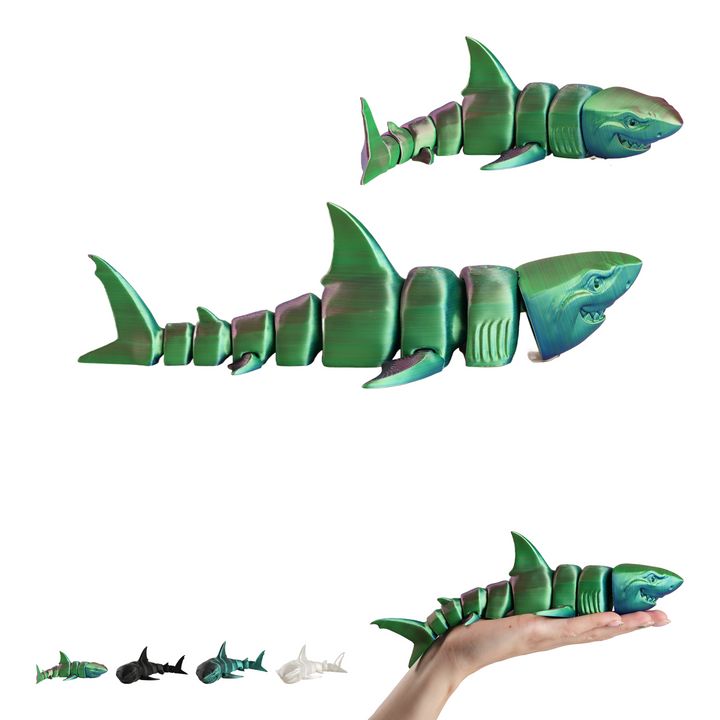
Our 24 cm articulated shark is modelled on a great white. The body is printed in one piece with the joints already in place, and the segments swing from side to side, the same way a real shark sweeps its tail. We snap on the head with its toothy jaw ourselves, so the shark arrives assembled and ready to move. The dorsal fin, pectoral fins, crescent tail and gill slits are all sculpted into the print.
- Hold the shark by the head and move it forward in a gentle zigzag: the segments behind follow in a wave, the way the body follows the head in water.
- Now keep the front still and swing only the rear segments and the tail. That is closer to how a great white swims: a steady front and a busy tail.
It measures 24 × 11 × 7 cm and weighs 99 g, so it spans a palm from wrist to fingertips and takes up little room on a desk. The segments move smoothly and quietly, which also makes it a fidget for the hands at the computer.
A shark skeleton for your keys
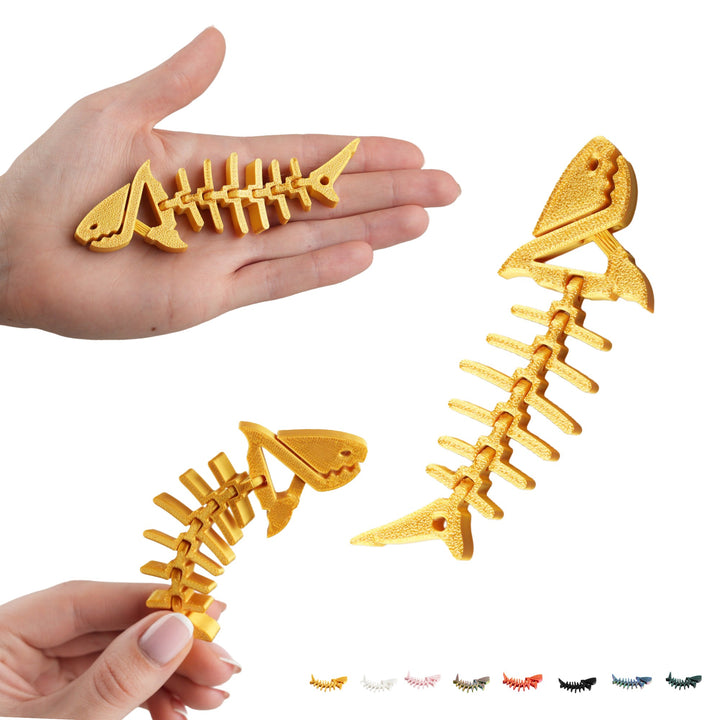
The 12 cm shark keychain is shaped like a shark skeleton and printed in one piece, with no glue and no screws. Every vertebra moves on its own, so the shark ripples in your hand, curls around a finger and settles back straight.
A real shark skeleton is made of cartilage, which rarely survives as a fossil; that is why ancient sharks are known mostly from their teeth. So the keychain is a stylised skeleton, not an anatomical model. For a backbone of real bone, compare it with our 15.5 cm T-rex skeleton, in which every vertebra, the tail and the legs move. Sharks, by the way, were swimming in the oceans long before the first dinosaurs.


More water creatures to go with the shark: the 17 cm octopus, whose eight tentacles move independently, and the 25 cm axolotl, an amphibian that spends its whole life in water. The sharks, the octopus and the axolotl are in our Flexi Animals collection, the shark keychain also in Desk Gadgets, and the T-rex skeleton among our Dinosaurs.
Safety: the 24 cm shark, the shark keychain and the 25 cm axolotl are marked 14+ because of small parts; we see them as collectibles and desk fidgets for teens and adults. All our articulated figures have small moving parts and are not suitable for children under 3.
Questions about sharks
Do sharks have bones?
No. A shark’s skeleton is made of cartilage, the same flexible tissue as in a human nose and ears. That is why fossil sharks are known mostly from their teeth.
Why does a great white have a white belly?
It is camouflage. From above, the dark back blends with the deep water; from below, the white belly blends with the bright surface.
Can a shark stop swimming?
It depends on the species. Some, like the nurse shark, rest on the seabed and pump water over their gills; others, including the great white, need to keep moving to breathe.
Products from this guide
-
Flexi Shark 24 cm, 3D Printed Articulated Great White Shark, Desk Fidget
Regular price 19,99 złRegular price -
Flexi Shark Keychain 12 cm, 3D Printed Articulated Shark Skeleton, Fidget
Regular price 19,99 złRegular price -
Octopus Fidget Toy 17 cm, 3D Printed Flexible Articulated Desk Toy, PLA
Regular price 39,99 złRegular price -
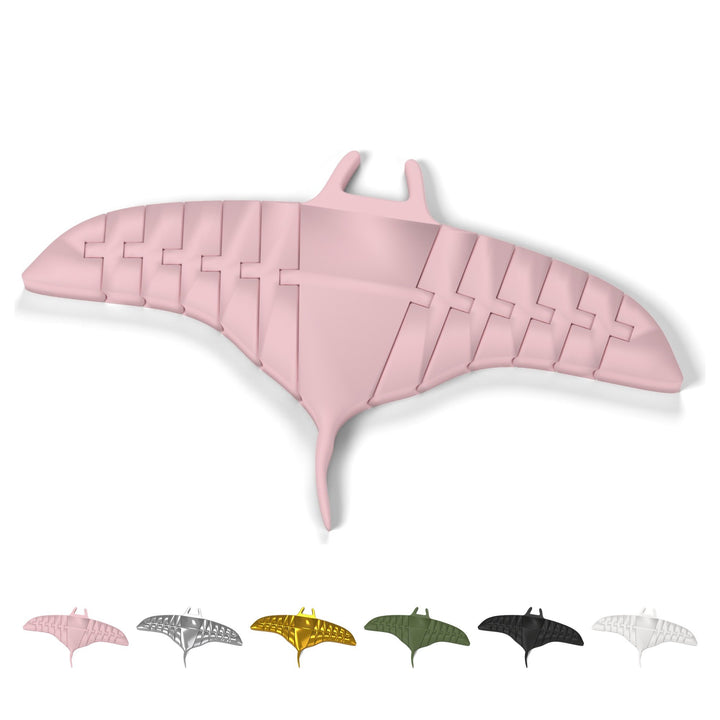
Flexi Manta Ray 16.8 cm, 3D Printed Articulated Manta Ray Figure, Desk Fidget
Regular price 19,99 złRegular price -
T-Rex Dinosaur Skeleton Figure 15.5 cm, 3D Printed Flexi Articulated, PLA
Regular price 39,99 złRegular price -
Flexi Axolotl 25 cm, 3D Printed Articulated Axolotl Figure, Desk Fidget
Regular price 19,99 złRegular price








Read next
Unicorn vs Pegasus vs Alicorn: What Is the Difference?
Unicorn vs Pegasus vs alicorn: who has the horn, who has the wings, where each one comes from in myth and history, and what an alicorn actually is.
Read →Types of Dinosaurs: Main Groups, T. rex and Stegosaurus
Types of dinosaurs explained: the main groups from theropods to sauropods, how to tell them apart, and what made T. rex and Stegosaurus so different.
Read →Moose Facts: Moose vs Elk and How Big Is a Moose
Moose facts in plain numbers: moose vs elk explained for British and American English, how big is a moose, how its antlers grow and where it lives.
Read →


