
Do Plant Pots Need Drainage Holes? Cachepot vs Planter
In short
- If you plant straight into soil, the pot needs a drainage hole and a saucer. A pot without a hole is a cover (cachepot): the plant stays inside in its plastic nursery pot.
- Watering a plant in a cover: water, wait a few minutes, then pour out whatever has collected at the bottom. Roots must never stand in water.
- Our covers on legs have no hole; our pots with a twist-lock saucer and the two-part Japandi planter do. All are PLA: indoors only, away from radiators and full summer sun.
Do plant pots need drainage holes? If the plant grows directly in the pot, yes: excess water has to go somewhere, or it sits at the bottom and the roots stand in it. That does not make pots without a hole useless. They are pot covers, also called cachepots, and they work differently: the plant stays in its own pot with holes, and the cover hides it and catches the water.
We print both kinds ourselves in Poland, from PLA, and this is the question we hear most. Below: the difference, how to water a plant in a cover without drowning it, and which of our pots has a hole.
Cachepot vs planter: what is the difference
A planter or plant pot is where the soil and roots live. It has a drainage hole in the base and usually a saucer underneath that catches what runs through.
A pot cover (cachepot) has no hole. It is a decorative outer shell: you drop the plastic nursery pot from the garden centre straight in, without repotting. The cover keeps the windowsill dry and makes a plain nursery pot look finished.
So the question "cover or pot" is really "do I want to repot?". If the plant is happy in its nursery pot and you just want it to look better, take a cover. If you want to plant into fresh soil, take a pot with a hole and a saucer.


Do plant pots need drainage holes?
For planting directly in soil, practically always. Most houseplants dislike wet feet: when water stays at the bottom of a pot without a hole, the lowest layer of soil never dries out and the roots start to rot.
A layer of pebbles at the bottom of a pot without a hole is a popular tip, but it does not replace a hole. The water still has nowhere to go; it only collects a little higher up.
A pot without a hole makes sense in one setup: as a cover, with a nursery pot inside that does have holes. Then you control the water yourself.
How to water a plant in a pot cover
- Water as usual, directly into the nursery pot inside the cover. Less is safer than more.
- Wait a few minutes until the water has run through the soil to the bottom of the cover.
- Lift the nursery pot and pour out whatever has collected in the cover, then put the plant back. Our covers do not absorb water, so a quick wipe inside is enough.
- Or water at the sink. Take the nursery pot out, water it over the sink, let it drain and only then put it back in the cover.
The rule is the same either way: excess water gets poured out, roots never stand in it. For succulents and cacti in small covers, water sparingly and check the bottom after every watering.
Read also: Dried Flower Vase in Japandi Style: Shape, Height and Sets · Housewarming Gifts That Suit Any New Home: Decor Ideas
Our pots: which have a hole and which do not
All six are ribbed, 3D printed from PLA and come in ten colours.
| Model | Height | Drainage hole | What goes inside |
|---|---|---|---|
| Pot cover on legs | 11.9 cm | no, it is a cover | nursery pot up to 9 cm |
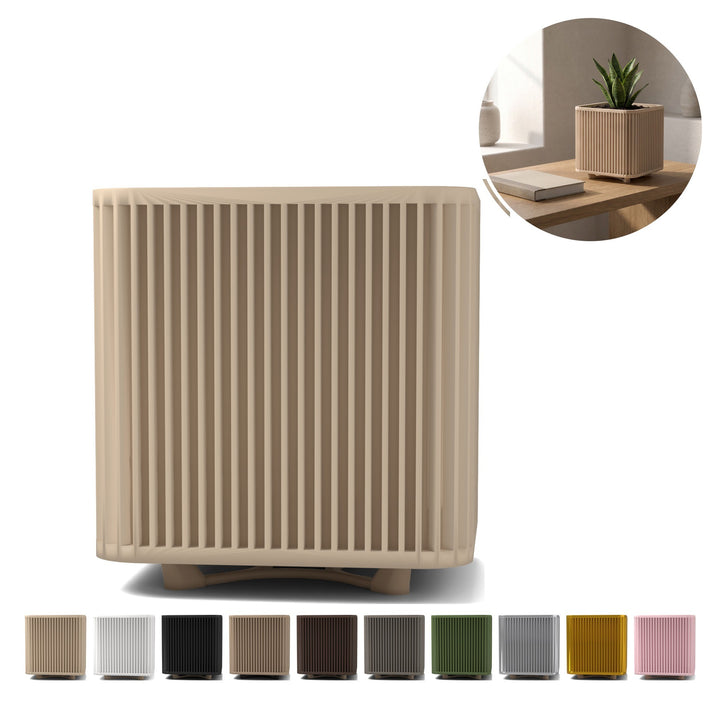
| Square cover on legs Shikaku | 11.9 cm | no, it is a cover | nursery pot up to 9–10 cm |
| Mid-century cover on tripod legs | 9.4 cm | no, it is a cover | nursery pot up to 7 cm |
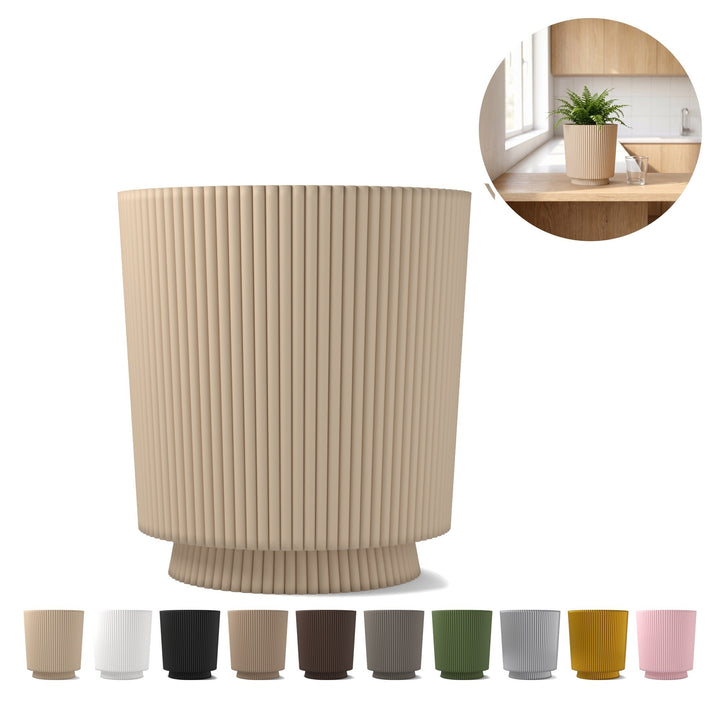
| Pot with twist-lock saucer | 10.7 cm | yes, plus saucer | soil directly, or a nursery pot up to 9 cm |
| Small pot with saucer | 10.2 cm | yes, plus saucer | soil directly, or a shallow nursery pot up to about 8 cm |
| Japandi planter with insert | 8.4 cm | insert yes, outer pot no | soil in the insert, a plant from a nursery pot up to about 7 cm |
On both pots with saucers, the saucer locks on with a twist and stays put when you carry the plant. Empty the saucer after watering. The small 10.2 cm pot is shallow, about 7 cm inside, which suits succulents, cacti and herbs.
The Japandi planter is a hybrid: a ribbed insert with a drainage hole sits in a smooth outer pot without one. You plant into the insert and the outer pot catches the excess water, so no separate saucer is needed. That water still has to be poured out.

Where to put them: heat and sun
PLA is light and does not shatter like ceramic, but it has one weak point: it softens above about 55 °C. That is why we say indoors only, and not everywhere indoors.
- Not on a windowsill above a radiator. The warm air rising from it in winter is exactly what PLA does not like.
- Not in full summer sun on a sunny windowsill, least of all the dark colours. A bright spot with a little shade or a sheer curtain is fine.
- Desk, shelf, sideboard: the legs on our covers lift the plant off the surface and keep the look light.
Our pot covers sit next to the Japandi vases in Home decor, and other everyday helpers for the flat are in Practical home. A plant in a nice cover is also an easy present: more ideas are in our housewarming gift guide.
See our pot covers and plant pots
Questions we often hear
Can I plant directly into a pot cover?
We would not. Without a hole, water stays at the bottom and the roots stand in it. Keep the plant in its nursery pot inside the cover, or choose one of our pots with a drainage hole and saucer.
Will my plant from the shop fit?
Measure the nursery pot across the top. The round cover on legs takes up to 9 cm, the square Shikaku up to 9–10 cm, the tripod cover up to 7 cm.
Are plants and soil included?
No. You get the cover or the pot (with saucer or insert, depending on the model) in the colour you choose.
Products from this guide
-
Plant Pot with Saucer Ribbed 10.7 cm, Drainage Hole, 3D Printed PLA
Regular price 53,99 złRegular price -
Plant Pot Cover with Legs, Ribbed Japandi 11.9 cm, 3D Printed PLA
Regular price 45,99 złRegular price -
Square Plant Pot Cover on Legs, Ribbed Japandi 11.9 cm Shikaku, 3D Printed
Regular price 56,99 złRegular price -
Japandi Plant Pot 8.4 cm with Drainage Insert and Cover Pot, PLA 3D Print
Regular price 50,99 złRegular price -
Plant Pot with Saucer 10.2 cm, Drainage Holes, Ribbed, 3D Printed PLA
Regular price 42,99 złRegular price -
Plant Pot Cover Ribbed Mid-Century 9.4 cm on Tripod Legs, 3D Printed PLA
Regular price 33,99 złRegular price






Read next
Gaming Room Ideas: Wall Decor, Desk and Cable Tidy
Gaming room ideas that start small: 27 dragon heads for the wall, stands for controller and headset, and holders that lift the power strip off the floor.
Read →Christmas Tree Decorating Ideas: Natural and Scandinavian
Christmas tree decorating ideas that work: the right order, a three-colour scheme, natural and Scandinavian looks, and proportions for a small tree.
Read →Jewellery Storage Ideas: No More Tangles, Losses or Scratches
Jewellery storage ideas that work: one compartment per type, everyday pieces within reach, a closed box for the rest and a tiny screw-lid container for trips.
Read →


