
Snake Facts: How Do Snakes Move Without Legs?
In short
- Snakes are reptiles with no legs, dry scaly skin, no eyelids and a forked tongue they use to smell.
- They move with muscles along a very long backbone: the body bends into waves and pushes against the ground, while wide belly scales grip.
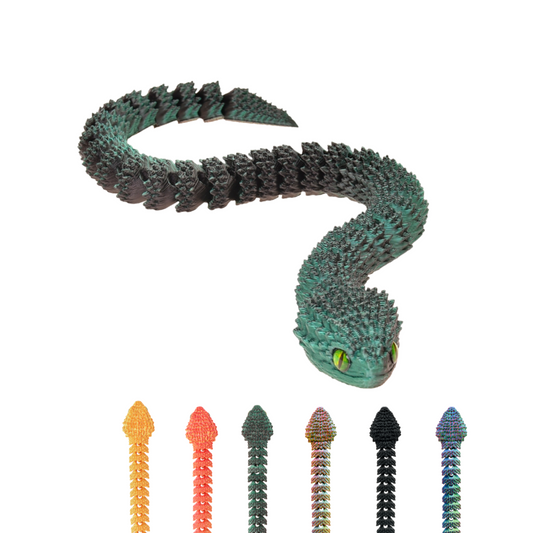
- Our articulated snake figures (21 cm, 27 cm, 80 cm XL and a 27 cm snake in a 10 cm egg) have a segmented body that shows the same S-shaped curves on a desk or shelf.
Snake facts tend to start with one question: how do snakes move without legs? The short answer is muscles, a very long backbone and belly scales that grip. Below: a fact sheet and the four ways snakes get around.
We print articulated snake figures, so we look closely at how real snakes bend. At the end: what a segmented figure can show and how our sizes compare. This is not a care guide; we make figures, not terrariums.
Snake facts at a glance
These points hold for snakes in general; individual species differ in the details.
| Question | Answer |
|---|---|
| What animal is it? | A reptile, like lizards, turtles and crocodiles |
| Body | Long, with no legs, covered in dry scales |
| Skeleton | A very long backbone made of many small bones, with ribs along most of the body |
| Body temperature | Depends on the surroundings, so snakes warm up in the sun |
| Food | Other animals, swallowed whole |
| Young | Most snakes hatch from eggs, some are born live |
| Where they live | On every continent except Antarctica: on the ground, in trees and in water |
Fun facts about snakes
- Snakes are not slimy. Their skin is dry and covered in scales.
- They smell with their tongue. The forked tongue picks up tiny scent particles and brings them to a special organ in the roof of the mouth.
- They cannot blink. Snakes have no eyelids. A clear scale covers each eye, which is why a snake always seems to stare.
- They have no ear openings. There are no outer ears, but snakes feel vibrations coming through the ground.
- They change their whole skin. As a snake grows, it sheds its old skin, often in one long piece, like pulling off a sock.
- Dinner goes down in one piece. Snakes cannot chew. Their jaws stretch very wide, so they swallow food whole.
One practical rule: leave wild snakes alone. Give them space and let them move on.
How do snakes move without legs?
A snake has lots of muscles along its backbone and ribs. Tightening them on one side, then the other, it bends its body and pushes against the ground. The wide scales on its belly help too: they grip the surface so the snake does not slide backwards. Four main ways of moving are usually described.
- The wave (serpentine). The most common way. S-shaped curves run down the body from head to tail, each pushing against stones, grass or bumps. Many snakes swim the same way.
- The caterpillar (straight line). Large, heavy snakes can creep forward in an almost straight line, with muscles moving the belly scales forward in small steps.
- The accordion (concertina). In tunnels or on branches, the snake bunches its back half into tight bends, holds on, stretches the front forward, then pulls the back after it.
- Sidewinding. On loose, hot sand some desert snakes move sideways, lifting parts of the body off the ground and leaving a row of separate tracks.


Read also: Gifts for Reptile Lovers: Lizards, Snakes and a Tarantula · Bearded Dragon Facts: Beard, Arm Waving and a 25 cm Figure
What an articulated snake figure shows
Our 27 cm articulated snake has a fully flexible segmented body, so it bends along its whole length. It is not a real skeleton, but the principle is similar: many small pieces in a row, each turning a little, add up to one long curve.
- Lay the snake flat and bend it into an S. That is the wave.
- Push the head forward along the curve and watch the bends travel back towards the tail.
- Bunch the middle into tight zigzags, then stretch the front part forward. That is the accordion.
What a figure cannot copy is the muscles and the gripping belly scales: here, your hands do the work. Still, it explains the wave better than a paragraph does.
Our snake figures compared
| Figure | Size | Colours | Where it fits |
|---|---|---|---|
| Articulated snake | 21 cm | 6 colour blends | A compact desk collectible |
| Articulated snake | 27 cm | 4 colour blends | Longer curves on a desk or shelf |
| Snake in egg | Snake 27 cm, egg 10 cm | 4 colours | A surprise figure to give, with an egg to display it in |
| XL snake | 80 cm | 4 colour blends | A statement piece for a shelf or sideboard; 14+, not a toy |
For showing movement we would pick the 27 cm snake: the longer the body, the more curves fit on the table. The 21 cm snake takes up less room, and its silk colour blends shift in zones, so every piece looks a little different. The snake in an egg is the one to give when the opening is part of the fun, and a nod to the fact that most snakes hatch from eggs. The 80 cm XL snake is pure decoration, with no play function. All of them are in our Snakes and Snakes in an Egg collections.


If reptiles are your thing, Flexi Animals has more: the 25 cm bearded dragon with jointed legs and a ten-link tail, the 17 cm chameleon that curls its tail, and the 15.5 cm T-rex skeleton, whose every vertebra moves, for comparing backbones. For gift ideas, see gifts for reptile lovers or our guide to dinosaur, axolotl and snake figures.
Safety: our figures have small moving parts and are not suitable for children under 3. The 80 cm XL snake and the 25 cm bearded dragon are marked 14+; the XL snake is a decorative collectible, not a toy.
Questions about snakes
Do snakes have bones?
Yes: a skull, a very long backbone of many small bones, and ribs. That backbone lets a snake bend into curves.
Why do snakes keep flicking their tongue?
To smell. The tongue carries scent into the mouth, where a special organ reads it.
Which snake figure fits on a desk?
The 21 cm or 27 cm snake. The 80 cm XL snake needs a shelf or sideboard of its own.
Products from this guide
-
Snake Figurine XL 80 cm, Articulated Flexible 3D Snake, Fantasy Display Decor
Regular price 39,99 złRegular price -
Snake in Egg 3D 27 cm, Articulated Snake Figurine, 10 cm Surprise Egg
Regular price 39,99 złRegular price -
Chameleon Flexi Lizard 17 cm, 3D Printed Articulated Fidget Toy, PLA
Regular price 39,99 złRegular price -
Bearded Dragon Articulated 25 cm, 3D Printed Flexi Lizard Figure, PLA
Regular price 19,99 złRegular price -
T-Rex Dinosaur Skeleton Figure 15.5 cm, 3D Printed Flexi Articulated, PLA
Regular price 39,99 złRegular price -
Snake Figurine 3D 27 cm, Fantasy Collectible Snake Statue for Desk Decor
Regular price 29,99 złRegular price -
Snake Figurine 3D 21 cm, Small Fantasy Snake Collectible Statue
Regular price 19,99 złRegular price



Read next
Unicorn vs Pegasus vs Alicorn: What Is the Difference?
Unicorn vs Pegasus vs alicorn: who has the horn, who has the wings, where each one comes from in myth and history, and what an alicorn actually is.
Read →Types of Dinosaurs: Main Groups, T. rex and Stegosaurus
Types of dinosaurs explained: the main groups from theropods to sauropods, how to tell them apart, and what made T. rex and Stegosaurus so different.
Read →Moose Facts: Moose vs Elk and How Big Is a Moose
Moose facts in plain numbers: moose vs elk explained for British and American English, how big is a moose, how its antlers grow and where it lives.
Read →


